The Inca Trail to Machu Picchu has been on my bucket list for years. I’d seen photos, read stories, and dreamed of walking the same stone steps the Incas once carved – but nothing could have prepared me for the reality of just how amazing (and challenging!) it would be. Four days. 42 kilometers on foot. Countless stone steps. And one of the most life-changing experiences of my life.
Here’s my day-by-day trekking journal of the classic 4-day Inca Trail – the highs, the lows, the tears, the laughter, and finally, the moment we reached Machu Picchu.
Day One: Warming Up the Legs
The trek began with a 5am start in Cusco, followed by a drive to Km 82, the official starting point of the Inca Trail. While our incredible porters got the gear ready, we grabbed our hiking poles and passed the first checkpoint, buzzing with excitement.


Day 1 covered about 12 km of hiking (roughly 27,000 steps for my little legs!), and while it was a steady incline, it was more of a “warm-up day” compared to what was to come. The views were unreal – sweeping mountain panoramas, ancient terraces, and plenty of snack breaks to soak it all in.


Highlights of Day One:
- Meeting my amazing trekking group (two Swiss, two Irish, and three Aussies including me).
- Exploring our first Incan archaeological site along the way.
- Being completely spoiled with a three-course lunch in the Andes including guacamole?? (how our chef carried fresh eggs, veggies, and even baking supplies blew my mind!)
- Arriving at camp to applause from our porters – tents set up, hot water ready to wash up, and even “tea time” with hot chocolate and biscuits before dinner.
We went to bed early with a 5am wake-up call ahead, buzzing with excitement for the journey to come.


Day Two: Conquering Dead Woman’s Pass
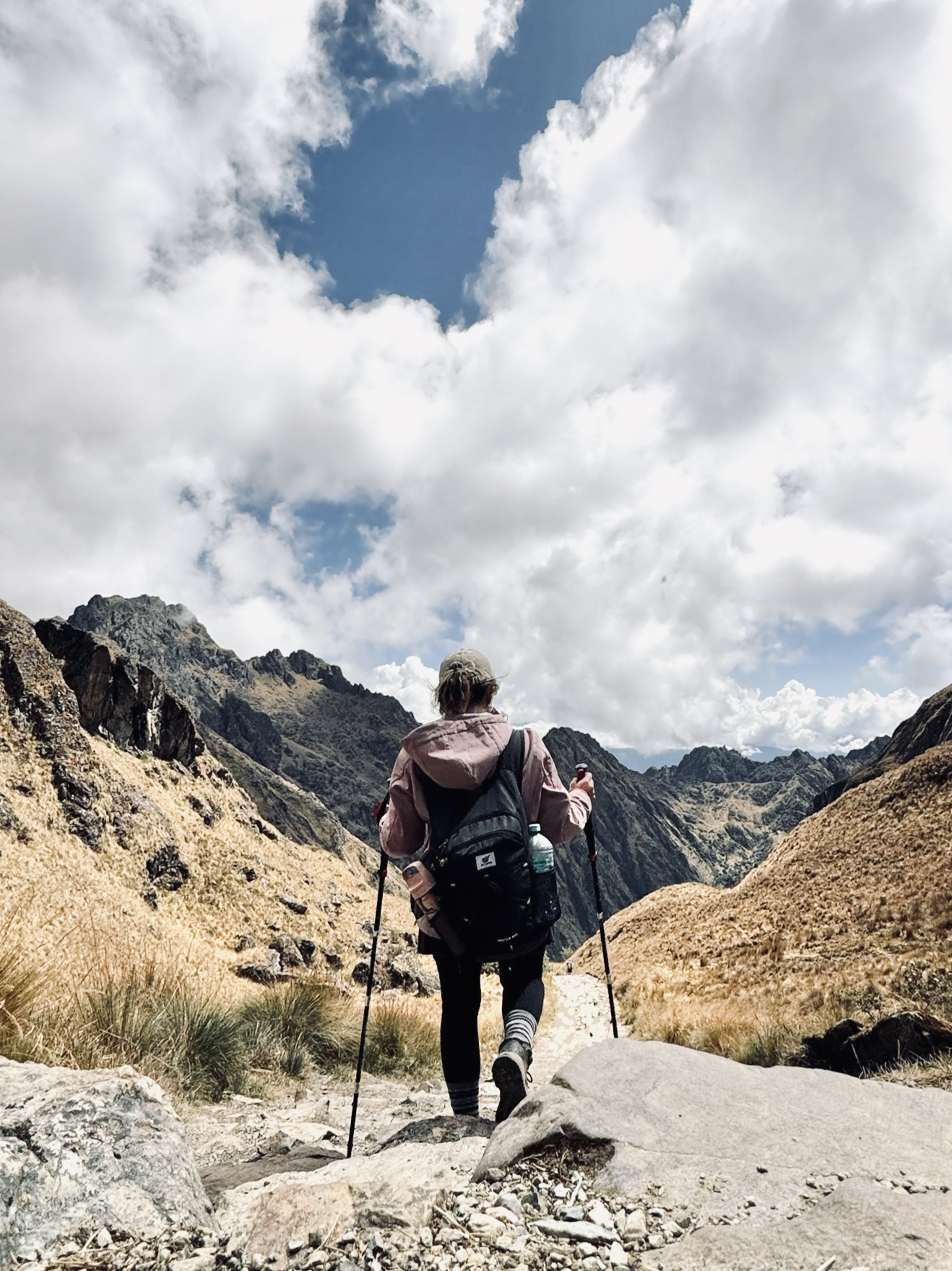
This was the big one. The hardest day of the trek. Our mission? To climb to Dead Woman’s Pass (4,215m / 13,828 ft) the highest point of the Inca Trail.


The ascent was brutal: 8 km of stone steps straight up. The altitude made it even harder – we were stopping every 10 minutes just to catch our breath. But the views kept us going. And when I finally reached the top, I completely broke down in tears. It wasn’t just about the mountain – it was about proving to myself that I could do hard things, both physically and emotionally.


After celebrating at the summit, it was another 8 km of steep downhill steps into the next valley (my knees were not impressed haha). But the scenery? Unreal. Cloud forests, ancient paths, and the knowledge that most of the stones we were walking on were original Inca construction.
Highlights of Day Two:
- Reaching the summit of Dead Woman’s Pass!!
- That first glimpse back over the valleys we’d crossed.
- Arriving at camp early, with time to nap, eat, and enjoy the view from one of the most beautiful campsites ever.


Day Three: Jungle Trails & Cake in the Andes
Day 3 was the longest day of the trek: 16 km (over 30,000 steps #blisters). Most of it was steep downhill, which was rough on the knees, but the scenery changed dramatically. Gone were the dry mountain passes – instead we entered lush cloud forest, with green mountains stretching endlessly in every direction.


The suspense was building, too. Toward the end of the day, we got our first glimpse of Machu Picchu mountain (though we got no spoilers of the city itself yet!).


Highlights of Day Three:
- Exploring more fascinating Inca ruins along the way.
- An insane lunch spread of Peruvian dishes whipped up by our trekking chef.
- The BIGGEST surprise – he baked us a full marble cake with jelly and icing… in the middle of the Andes?!
- Camping one last night under the stars, knowing Machu Picchu was just hours away.


Day Four: Machu Picchu at Sunrise 🌄✨
The final day started with a 3:30am wake-up call. The energy at camp was electric — this was it! After waiting at the last checkpoint, we hiked the final stretch of the trail, including the infamous “Monkey Stairs” (they’re basically vertical).


And then… we reached the Sun Gate.
That first glimpse of Machu Picchu in the golden morning light is something I’ll never forget. Watching the sun rise over the city, with not a single cloud in sight, felt like pure magic.


We then descended into the citadel itself, arriving at the iconic viewpoint you’ve seen in every photo – except this time, it was real. I was looking at a Wonder of the World. My heart could barely handle it.

Afterward, our guide gave us a full tour of Machu Picchu, which was the perfect way to end the journey. The only weird part? After four days in the wild, suddenly being surrounded by so many people again.


How the Inca Trail Changed Me
The Inca Trail isn’t just a hike. It’s four days of pushing your limits, laughing with strangers who become friends, standing in awe of ancient history, and discovering strength you didn’t know you had.
Yes, it’s hard. Yes, your legs (and knees) will hate you. But when you finally step through the Sun Gate and see Machu Picchu for the first time – it is 1000% worth it.

If you’ve ever dreamed of doing the Inca Trail to Machu Picchu, my advice is simple: do it. It might just might be the most incredible adventure of your life (it certainly was for me!)
Planning a trip to Peru? Check out my 3-Week Peru Itinerary here!
Peru Helpful Links
Where to stay in Cusco:
Luxury: Saska Boutique Hotel
Mid-Range: Hotel Amerinka
Budget: Golden Inca Hotel
Top Tours from Cusco
– From Cusco: Machu Picchu Full-Day Tour
– Cusco: Humantay Lake Tour with Breakfast and Buffet Lunch
– Cusco: Half-Day City Tour with Sacsayhuaman and Q’enco
– Cusco: Sacred Valley, Pisac, Ollantaytambo, Salt Mines Moray
– Cusco: Sacred Valley, Pisac, Ollantaytambo, Salt Mines Moray
How to Get Around Peru
Getting around Peru can be an adventure in itself, but it’s very doable with a little planning. For longer distances, domestic flights are a huge time-saver, while comfortable long-distance buses connect most major cities and tourist routes.
One of the easiest and most popular options for first-time visitors is Peru Hop, a hop-on, hop-off bus service designed specifically for travellers. It connects destinations like Lima, Paracas, Huacachina, Arequipa, and Cusco, with flexible stops, local guides, and hotel pick-ups included making it a stress-free way to see the country.
For shorter trips or exploring at your own pace, taxis, uber, and car rentals round out the options nicely.
Peru SIM Card: Airalo eSIM
Staying connected in Peru is a must for maps, transport apps, bookings, and Googling lomo saltado near me” (trust me). I used Airalo, an eSIM app that lets you download a Peru data plan before you even land.
There’s no need to swap physical SIM cards or hunt down a store at the airport. Just activate your eSIM and you’re online the moment you arrive – easy, affordable, and super convenient.
👉 Get your Peru eSIM with Airalo here
Disclaimer: This post contains affiliate links, which means I may earn a small commission if you purchase through these links – at no extra cost to you.
🦙 More Peru Posts
Check out these Peru blog posts:


Something went wrong. Please refresh the page and/or try again.


Leave a Reply